
Published September 12, 2026
What $1 Million Really Buys You in Maui

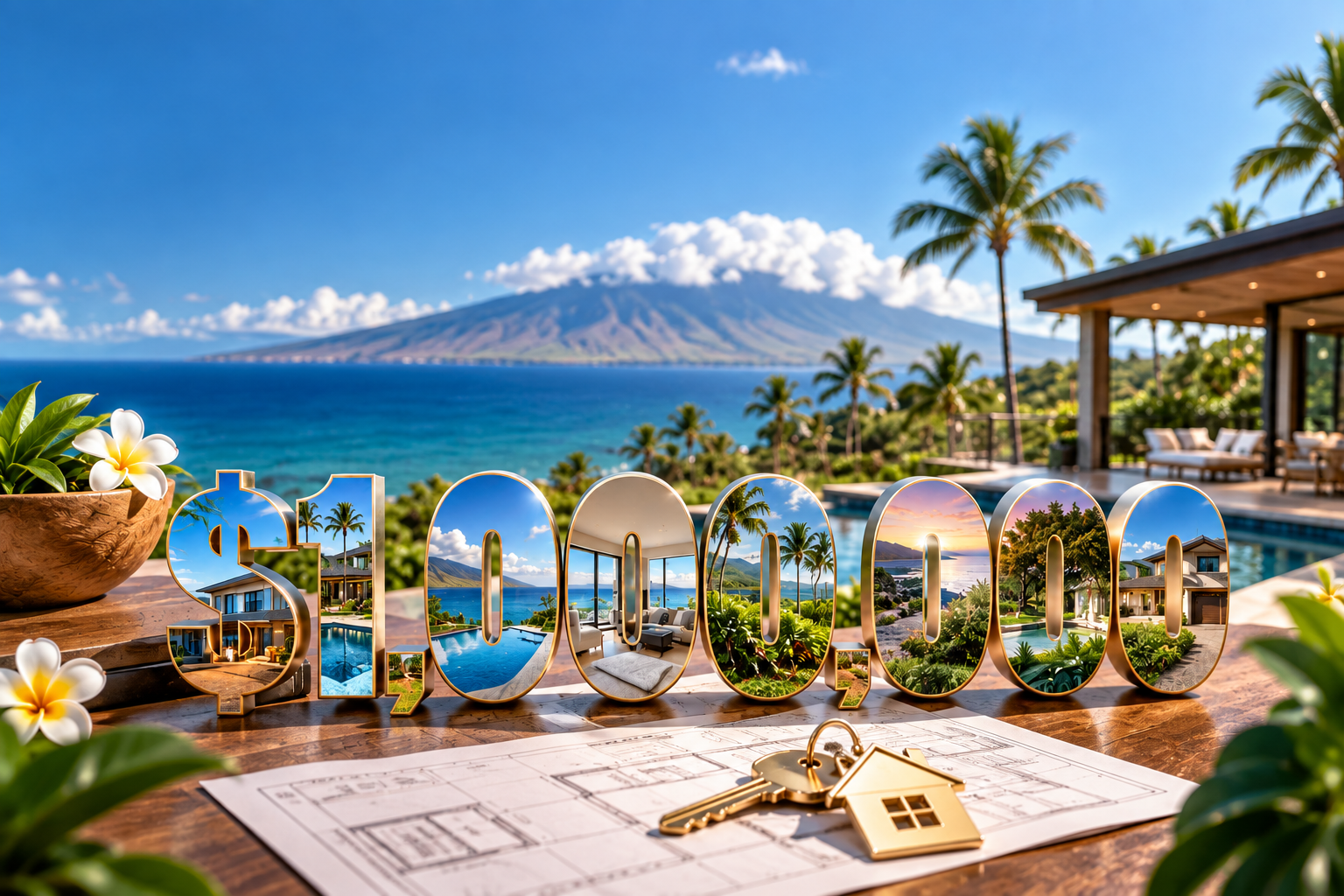
If you’re considering buying in Maui, the price tag is only the beginning. Here’s what actually determines whether a $1 million property is a great opportunity—or simply an expensive purchase.
Maui real estate comes with a reality that can be easy to overlook:
A million-dollar budget does not buy the same thing everywhere on the island.
Depending on where you look, that budget could mean a condominium, a smaller single-family home, a property needing updates, or something completely different.
And that's exactly why buyers shouldn't shop by price alone.
Location Can Change Everything
Maui isn't one uniform housing market.
A $1 million budget in Kihei may give you a very different set of options than $1 million in Wailea, Upcountry Maui, or West Maui.
Location affects more than the purchase price. It can influence views, lot size, proximity to beaches and amenities, property type, neighborhood character, and long-term demand.
This is why two properties with similar price tags can offer very different ownership experiences.
Before comparing prices, compare what the locations actually offer.
Don't Assume a Million-Dollar Home Is a Luxury Home
On the mainland, $1 million may still be considered a luxury price point in many markets.
Maui is different.
Because land is limited and demand for desirable locations can be strong, buyers can encounter significantly different property types within the same price range.
You may find a beautifully renovated condo.
You may find a modest single-family home.
You may find a property with incredible potential that needs significant work.
You may also find something that looks impressive online but doesn't make as much sense once you examine the numbers.
The price alone doesn't tell you the story.
The View Can Be Worth a Lot
In Maui, views aren't just a nice bonus.
Ocean views, mountain views, privacy, elevation, and proximity to the water can have a meaningful effect on how a property is perceived and priced.
But buyers should be careful about paying a premium simply because a listing has beautiful photographs.
Ask yourself:
How much of the view is actually usable?
Is it protected or could it change?
What does the property look like from different rooms?
Does the location offer the lifestyle you're looking for?
A beautiful photograph can sell a dream.
Your due diligence should tell you whether the dream makes sense.
The Property's Condition Matters More Than You Think
Two homes at the same price can have completely different financial implications.
One might be move-in ready.
Another might require a new roof, updated systems, exterior work, or significant renovation.
With Maui's climate and exposure to the elements, maintenance deserves serious consideration.
Before making an offer, understand the property's current condition and think about what you'll potentially need to spend after closing.
The cheapest property to buy isn't always the cheapest property to own.
And Then There Are the Ongoing Costs
Buyers often focus heavily on the purchase price.
But ownership comes with recurring expenses.
Depending on the property, you'll need to consider property taxes, insurance, utilities, maintenance, landscaping, repairs, HOA fees, and potentially property management or rental-related costs.
For condos, association finances deserve particular attention.
A property with a lower purchase price can still become expensive if its ongoing costs are significantly higher.
Look at the entire financial picture—not just the number on the listing.
What If You Want to Rent It?
This is where assumptions can get particularly risky.
Some buyers purchase Maui property with the expectation that rental income will offset ownership costs.
That strategy can work for certain properties, but rental potential should never be assumed.
Whether a property can be used as a short-term rental can depend on county regulations, zoning, permits, property classification, and association rules.
If rental income is part of your plan, verify the property's actual permitted use before you make a purchase decision.
Don't buy based on an income projection you haven't verified.
What Does $1 Million Mean to You?
This may be the most important question.
Are you looking for a full-time home?
A second home?
A future retirement property?
A place for your family?
A property you hope to rent?
A long-term real estate asset?
Your answer can completely change what makes a property “worth it.”
For one buyer, a smaller condo near the beach may be ideal.
For another, a larger home farther from the resort areas may make much more sense.
There is no universally perfect Maui property.
There is only the property that makes sense for your goals.
Should You Wait for a Better Deal?
Maybe.
But don't confuse waiting with having a strategy.
If you're not financially ready, waiting can be smart.
If you haven't figured out where on Maui you want to live, waiting can be smart.
If the available properties don't fit your needs, waiting can be smart.
But waiting simply because you're convinced the market will hit a specific price point can be much harder to predict.
Markets don't move according to our preferred schedule.
Instead of asking, “Will prices be lower next year?”, consider asking:
“If I found the right property today at a price that makes sense, would I be ready to act?”
That is a question you can actually prepare for.
The Real Value of a Maui Property
The best Maui purchase isn't necessarily the most expensive home, the biggest home, or the property with the most impressive listing photos.
It's the property where the price, location, condition, ownership costs, and intended use all make sense together.
That's what buyers should be looking for.
Not just a beautiful property.
A smart purchase.
Maui Real Estate FAQ
1. Is $1 million enough to buy a home in Maui?
Yes, but what that budget can purchase varies significantly by location, property type, condition, and other factors. Buyers should evaluate individual properties rather than assuming a specific price range guarantees a particular type of home.
2. What is the best place to buy a home in Maui?
There isn't one best location for every buyer. Wailea, Kihei, Makena, West Maui, Upcountry, and Central Maui each offer different lifestyles and property options.
3. Is buying a Maui property a good investment?
It can be, but no property should be considered a guaranteed investment. Purchase price, ongoing expenses, rental restrictions, market conditions, and your long-term objectives all matter.
4. Can I rent out my Maui property?
Potentially, but it depends on the property's zoning, permitted use, county regulations, permits, and any applicable association restrictions.
5. What should I prioritize when buying in Maui?
Start with the fundamentals: location, property condition, price, ownership costs, permitted use, and how well the property fits your long-term plans.
The Bottom Line
In Maui, the question isn't simply, “What can I afford?”
It's “What makes sense for me?”
A million dollars can buy very different properties across the island. The smartest buyers understand those differences, look beyond the photographs, and evaluate the complete cost and potential of a property before making a decision.
Because in Maui real estate, the right property isn't necessarily the one that looks the best—it’s the one that makes the most sense.

Nicole Kovach
| Nicole Kovach | Keller Williams Realty Maui
or another way