

Categories
CommunityPublished September 17, 2026
Why Two Maui Homes With the Same Price Can Be Completely Different Buys

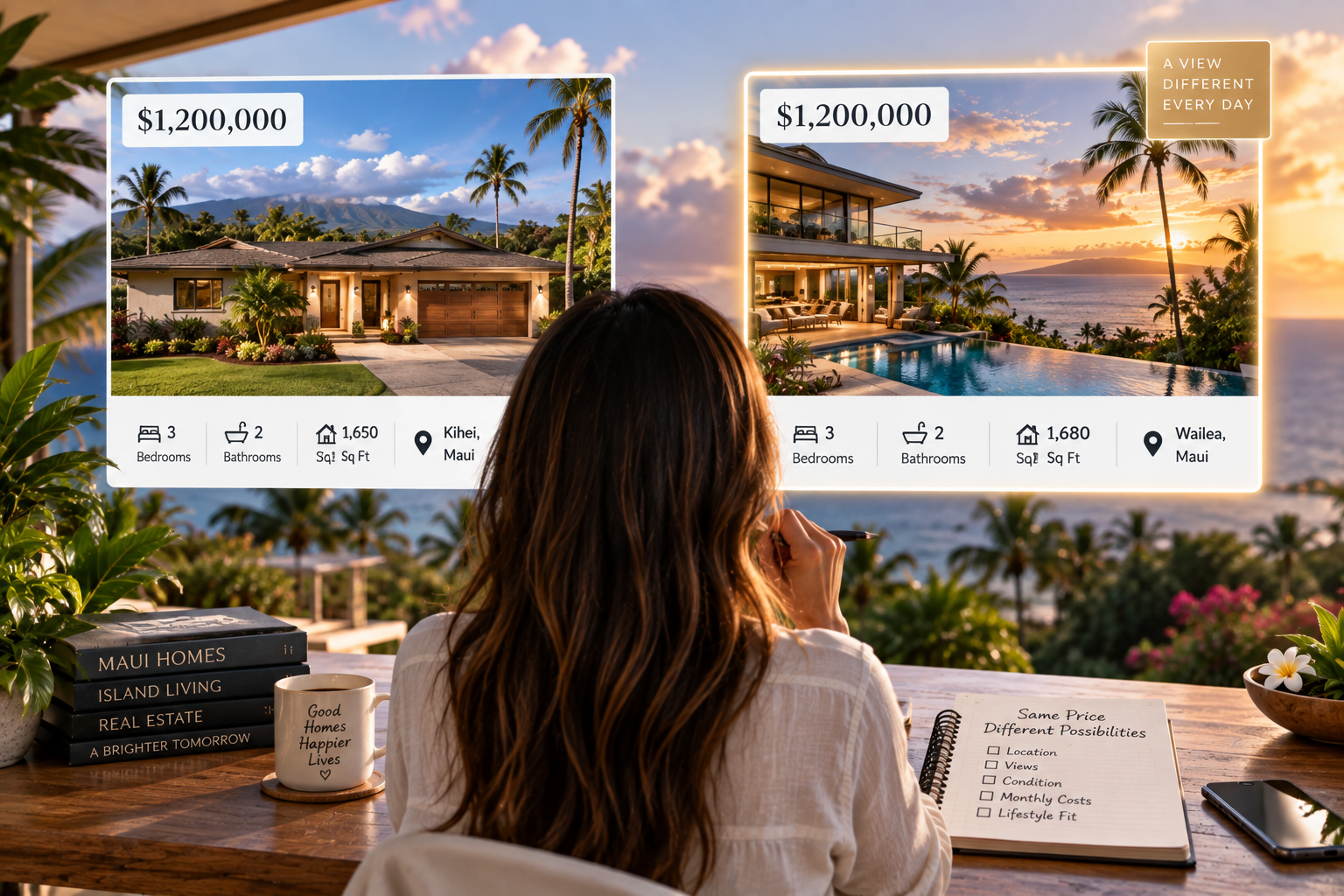
Two Maui properties can have the same asking price and still offer completely different value. Here’s what buyers should look at before deciding which one is actually worth it.
If you're shopping for a home in Maui, it's tempting to compare properties by the easiest number: the price.
One home is $1.2 million.
Another home is also $1.2 million.
On paper, they appear comparable.
But real estate doesn't work that way.
A property’s price is only one piece of the equation. Location, condition, views, ownership costs, property type, neighborhood, permitted use, and future potential can all change what you're actually getting for your money.
That's why two Maui homes with the exact same asking price can be completely different purchases.
And sometimes, the property that looks more expensive at first glance may actually make more sense.
The Price Is the Starting Point, Not the Answer
When buyers see a property priced at $1.2 million, the natural question is whether it's affordable.
A more useful question is:
What am I getting for $1.2 million?
That means looking beyond the number and understanding the property itself.
Is it a condo or single-family home?
Is the property recently renovated or likely to require significant work?
Does it have a desirable view?
How much privacy does it offer?
What are the monthly ownership costs?
How does the property compare with recent sales?
What restrictions come with it?
Those details can make two properties with identical price tags feel completely different once you understand the full picture.
Location Can Make Two Similar Homes Completely Different
Maui is not one uniform real estate market.
A property in Kihei can offer a very different lifestyle from one in Wailea.
A home in Upcountry Maui can feel completely different from a property near the resort areas.
Even properties within the same community can have significant differences depending on their exact location.
One might be closer to the beach, restaurants, and everyday services.
Another might offer more privacy and space.
One may have easier access.
Another may offer better views.
One may be surrounded by newer development.
Another may have a more established neighborhood feel.
Neither is automatically better.
The better property is the one that fits what the buyer actually wants from Maui.
A View Can Change the Value Dramatically
If you're buying in Maui, chances are a beautiful setting is part of the appeal.
Ocean views, mountain views, sunsets, privacy, and outdoor living can all influence how a property is valued and how enjoyable it is to own.
But buyers should be careful about assuming that every “ocean view” is equal.
A property might have a wide, unobstructed panorama.
Another might have a partial glimpse between neighboring homes.
One may offer the view from the living room and lanai.
Another might require stepping outside or moving to a particular part of the property.
The difference can be significant.
And if you're paying a premium for a view, you should understand exactly what you're paying for.
A beautiful photograph doesn't tell you how the property actually feels from day to day.
The Cheaper Property May Cost You More
Here's where buyers can get caught off guard.
Imagine two properties are both priced around $1.2 million.
Property A is beautifully maintained and recently updated.
Property B is less expensive to own upfront but needs a roof replacement, exterior work, landscaping, or significant interior updates.
At first glance, Property B might seem like the opportunity.
But once you start adding renovation and maintenance costs, the difference can disappear quickly.
The same principle applies to condominiums.
A lower purchase price may come with higher association fees, special assessments, aging infrastructure, or other expenses.
The purchase price tells you what it costs to buy the property. It doesn't necessarily tell you what it will cost to own it.
Condo Fees Can Change the Equation
This is particularly important when comparing condos.
A buyer might see two condos at similar prices and naturally lean toward the one with the lower monthly HOA fee.
But that's not enough information.
You also want to understand what the association fee covers, how financially healthy the association is, whether reserves are adequate, whether major projects are coming, and whether special assessments are possible.
A higher monthly fee isn't automatically a bad thing if it reflects services, maintenance, reserves, or amenities that provide real value.
Likewise, a low monthly fee isn't automatically a bargain.
The question is what you're actually getting for the money.
The Same Price Can Mean Different Lifestyles
This is something online searches don't always communicate well.
One property might give you a larger home farther from the areas you frequent.
Another might give you less space but put you closer to the beach, restaurants, shopping, and activities.
One might prioritize privacy.
Another might prioritize convenience.
One might work beautifully as a full-time residence.
Another might make more sense as a second home.
There isn't a spreadsheet that can completely answer those questions.
At some point, buyers need to think about how they actually want to live in Maui.
Don't Compare Properties Without Comparing Their Intended Use
This becomes particularly important if you're considering rental income.
A buyer may compare two condos and assume the one with the lower price is automatically the better opportunity.
But if the intended rental use isn't permitted in the same way—or at all—the financial assumptions can change dramatically.
Maui County has specific rules surrounding short-term rental accommodations, and individual properties can also be subject to zoning, permitting, property classification, and association restrictions.
If rental income is part of your plan, verify the property's permitted use before treating projected income as part of your financial equation.
Don't compare two properties based on income that one of them may not actually be able to generate.
What About Resale?
Even if you aren't thinking about selling anytime soon, you should still think about who might want the property after you.
That's not about trying to predict the future.
It's simply about understanding the property's broader appeal.
Would the location appeal to a wide range of buyers?
Is the property easy to maintain?
Are there unusual restrictions?
Does the layout make sense?
Are there features that genuinely add value?
Or are you paying a premium for something very specific that may limit your future buyer pool?
You don't need to turn every home purchase into an investment analysis.
But you also shouldn't completely ignore the fact that real estate is an asset you may eventually need to sell.
The “Best Deal” Isn't Always the Most Obvious One
This is where having someone who knows the local market can make a difference.
A buyer looking at two properties online might see:
Property A: $1.2 million
Property B: $1.2 million
A local Realtor may see a completely different comparison.
One property may be priced competitively based on recent sales.
The other may have been sitting on the market because buyers haven't responded to the price.
One may have a strong location but need cosmetic work.
The other may look perfect but carry significant ongoing costs.
One may have characteristics that buyers consistently seek.
The other may appeal to a much narrower audience.
The listing gives you the properties. Local context helps you understand the difference between them.
This Is Why Buyers Shouldn't Shop by Price Alone
Price is important.
Of course it is.
But if price becomes the only filter, buyers can miss the bigger picture.
A better comparison looks at the complete package:
What is the property?
Where is it?
What condition is it in?
What will it cost to own?
How can it be used?
How does it compare with recent sales?
Does it fit the way you actually want to live?
Once you start asking those questions, you may find that the property you initially liked the most isn't necessarily the one that makes the most sense.
And that's okay.
The purpose of looking at multiple properties isn't just to find something you like.
It's to understand what your money can actually buy.
What Should Maui Buyers Compare Before Making an Offer?
Before deciding between two similarly priced properties, take the time to understand the complete picture.
Look at the property's location and neighborhood.
Compare recent comparable sales.
Understand the condition and likely maintenance needs.
Review HOA or association costs when applicable.
Investigate insurance and property taxes.
Confirm any rental or usage restrictions.
Consider the property's views, privacy, accessibility, and surrounding environment.
And most importantly, think about whether the property fits your actual goals.
Because if you're going to spend $1 million, $2 million, or more on Maui real estate, you should know exactly what you're getting for it.
The Maui Property Market Rewards Curious Buyers
The strongest buyers aren't necessarily the ones who know everything about real estate.
They're the ones who ask questions.
They don't just ask, “What's the price?”
They ask why the property is priced that way.
They don't just ask, “Is there an ocean view?”
They ask how the view compares with other properties.
They don't just ask, “What's the HOA?”
They ask what that fee covers and what the association's financial position looks like.
They don't just ask, “Can I rent it?”
They verify whether the intended use is actually permitted.
That curiosity can lead to better decisions.
And when you're making a significant purchase in a market as unique as Maui, better questions can be just as important as finding the right property.
The Bottom Line
Two Maui homes can cost exactly the same and still be completely different buys.
One may offer better value.
One may better fit your lifestyle.
One may require less maintenance.
One may have fewer restrictions.
One may have stronger long-term appeal.
And sometimes, the difference isn't obvious until someone takes the time to look beyond the listing.
Don't just ask what a Maui property costs. Ask what you're actually getting for that price.
That's where the real comparison begins.
Maui Real Estate FAQ
1. Why can two Maui homes with the same price have different values?
Price doesn't capture every characteristic of a property. Location, condition, views, property type, ownership costs, permitted use, amenities, and comparable sales can all influence a property's value.
2. What should I compare when looking at two Maui homes?
Compare their location, condition, recent comparable sales, views, ownership costs, property taxes, insurance, HOA fees if applicable, permitted use, and how well each property fits your lifestyle and long-term goals.
3. Is a lower-priced Maui property always a better deal?
No. A lower purchase price can come with higher maintenance costs, assessments, HOA expenses, renovation needs, or other considerations that affect the property's overall value.
4. What should I know when comparing Maui condos?
Look beyond the purchase price and monthly HOA fee. Review association finances, reserves, insurance, rules, potential assessments, rental restrictions, and upcoming projects.
5. Should I consider resale when buying a Maui home?
Yes. Even if you intend to own the property for many years, understanding its location, appeal, restrictions, and potential future buyer pool can be useful when evaluating the purchase.
6. How can a Maui Realtor help me compare properties?
A local Realtor can help put individual properties into context by examining comparable sales, neighborhood characteristics, market conditions, property-specific considerations, and the buyer's intended use and goals.

Nicole Kovach
| Nicole Kovach | Keller Williams Realty Maui
or another way