

Published October 7, 2026
Why Some Maui Homes Sell While Others Sit

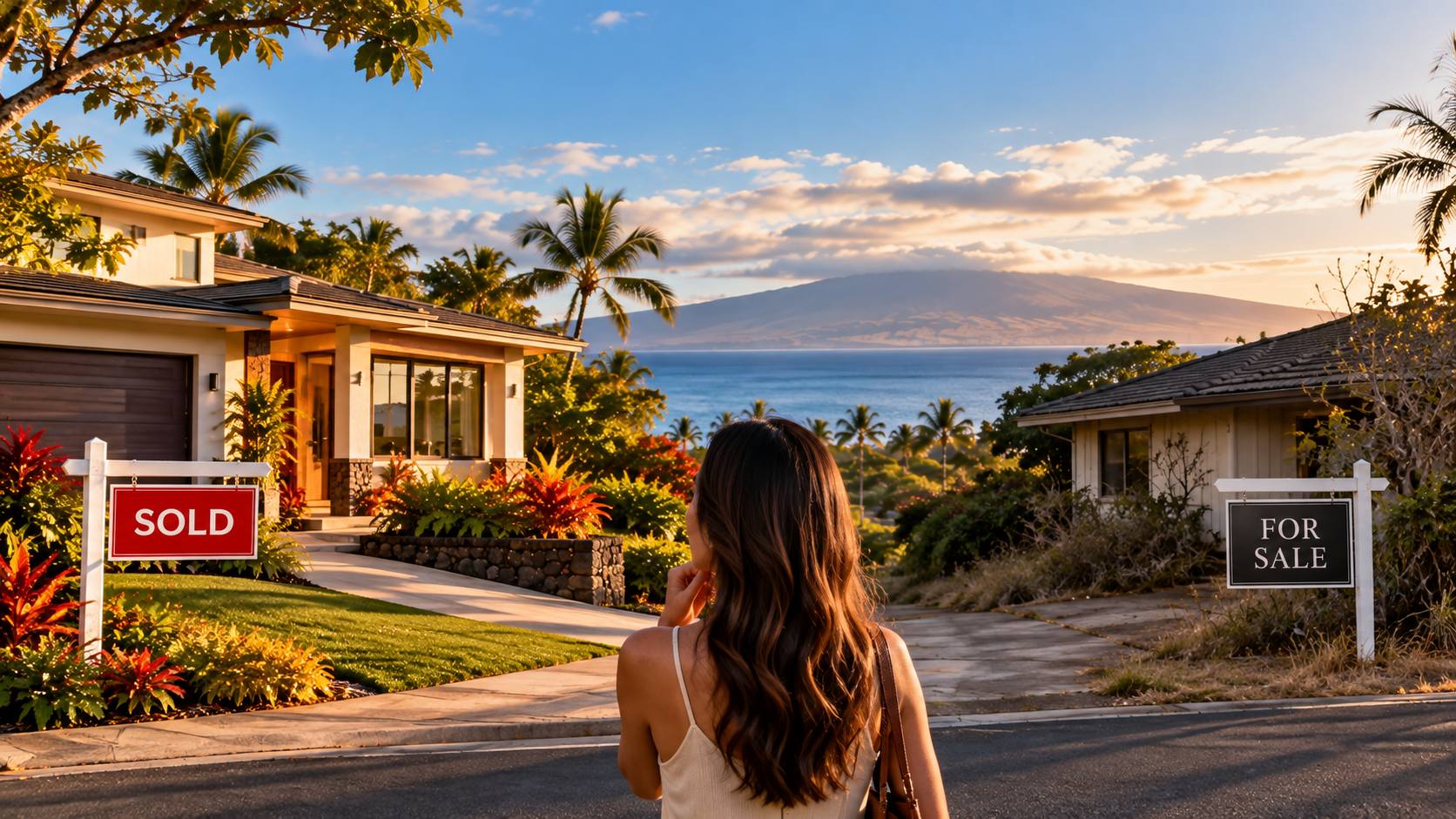
In the same Maui market, one property can attract attention while another sits for months. The difference isn't always the home itself. Often, it's how the property is positioned, priced, presented, and compared to the competition.
A Maui Home Can Be Beautiful and Still Sit on the Market
A beautiful home does not automatically mean a fast sale.
Maui's September 2026 market data shows why. Single-family homes had a median sales price of approximately $1.15 million, with homes spending about 101 days on the market. Condo sales increased significantly year over year, but condos were also taking considerably longer to sell, with median days on market around 170 days.
The market is still moving. Buyers are still purchasing. But they have options, and that changes how they evaluate properties.
A home can have a great view, a beautiful kitchen, and a desirable location and still struggle to attract an offer if the price, presentation, condition, or overall value does not make sense compared with what else is available.
That is one of the most important realities for Maui sellers to understand.
The Market Does Not Reward Every Listing Equally
It is easy to look at overall market statistics and assume they tell the entire story. They do not.
Within the same Maui market, individual properties can perform very differently.
Recent third-quarter data showed that nearly half of active single-family listings were priced below their original asking price. Condominiums showed a similar pattern, with about 45% of active listings priced below their original asking price.
That does not necessarily mean sellers made a mistake by starting higher. Every property has its own circumstances.
But it does show that buyers are not simply accepting the first price they see.
They are comparing.
They are looking at what else is available, what has recently sold, how long properties have been sitting, whether prices have been reduced, and what they are actually getting for their money.
Your home is not being evaluated in isolation. It is being evaluated against everything a buyer could choose instead.
Price Is More Than Just a Number
One of the biggest mistakes a seller can make is looking at another property nearby and assuming it should determine the price of their own.
Two homes in the same general area can have very different values.
Lot size, condition, renovations, views, privacy, floor plan, parking, outdoor space, HOA fees, building condition, location within a community, and even the direction a home faces can influence how buyers perceive value.
The asking price needs to make sense within that specific context.
Pricing a property is not simply about choosing a number that sounds good or adding a premium because the home has features you personally value.
It is about understanding what the current buyer is likely to compare it against and where your property realistically fits within that landscape.
The First Few Weeks Matter
When a property first comes on the market, it receives an important opportunity to make an impression.
That does not mean every home needs to sell within a few days. Maui real estate can naturally take time, particularly for higher-priced properties, unique homes, and certain condo markets.
But the longer a property sits without meaningful interest, the more questions buyers may begin to ask.
Is it overpriced?
Is something wrong with it?
Has the seller already turned down offers?
Will the price eventually come down?
Buyers notice market history.
That is why it is important to pay attention to how a property is performing rather than simply assuming that more time on the market will eventually produce the right buyer.
Sometimes the right response is a price adjustment. Sometimes it is better presentation. Sometimes the marketing needs to change. And sometimes the property itself needs to be reassessed.
Beautiful Photos Are Not Enough
Professional photography matters. A strong listing presentation matters. But beautiful photos cannot solve every problem.
A buyer looking at a Maui property is thinking beyond the first impression.
They may be considering the condition of the roof, windows, appliances, flooring, plumbing, electrical systems, landscaping, or other major components.
For condos, they may also be looking at association finances, maintenance, reserves, insurance, upcoming projects, and special assessments.
A property can photograph beautifully and still leave a buyer with questions once they start looking deeper.
The goal of marketing should not be to hide those questions.
It should be to present the property accurately while helping buyers understand why the home represents a compelling opportunity.
Buyers Are Looking at the Whole Cost of Ownership
The purchase price is only one part of the financial picture.
For a Maui property, buyers may also need to consider property taxes, insurance, HOA or maintenance fees, utilities, repairs, landscaping, property management, and other ongoing expenses.
For condos and resort properties, association fees can make a significant difference in the overall cost of ownership.
A lower asking price does not automatically make one property cheaper to own.
Likewise, a higher HOA fee does not automatically make a property a bad purchase. What matters is what those fees cover, how financially healthy the association is, and what the buyer is receiving in return.
The real question is not simply, “What is the asking price?”
It is, “What will owning this property actually cost me?”
The Neighborhood Matters More Than the Zip Code
Maui is not one single real estate market.
Conditions can vary considerably between South Maui, West Maui, Upcountry, Central Maui, and other communities across the island.
Even within the same general area, two neighborhoods can offer very different experiences.
A buyer looking for resort amenities and walkability may prioritize something completely different from a buyer looking for privacy, space, or a more residential environment.
This is why local context matters.
A property should not only be evaluated based on its address. Buyers and sellers should understand what is happening around that property, what comparable homes are doing, how much competition exists, and what type of buyer is actually looking in that area.
Sometimes the Property Isn't the Problem
When a home is sitting on the market, the natural assumption is that something must be wrong with the property.
That is not always the case.
Sometimes the home is perfectly good but priced incorrectly.
Sometimes the price is reasonable but the listing does not communicate the property's strongest features.
Sometimes the photographs do not show the home well.
Sometimes the property is competing against a newer or more updated home at a similar price.
Sometimes the market simply has fewer buyers for that particular type of property.
And sometimes the seller's expectations are based on what the market looked like several months or even a year ago.
Understanding the reason behind a property's lack of activity is more useful than simply saying, “It hasn't sold yet.”
What Buyers See Is Different From What Sellers See
This is one of the hardest parts of selling a home.
Sellers know the property personally. They remember the renovation they invested in, the improvements they made, the mornings spent on the lanai, and the memories created inside the home.
Buyers do not have that history.
They see the asking price.
They see the photos.
They see the condition.
They see the view.
They see the neighborhood.
And then they compare all of it with other properties.
That difference in perspective matters.
A seller may think, “We completely remodeled the kitchen.”
A buyer may think, “The house is still priced higher than another remodeled home nearby.”
Neither perspective is necessarily wrong. But understanding the buyer's perspective is critical when deciding how to position a property.
The Goal Isn't to Be the Most Expensive Home
A common misconception is that a higher asking price creates more negotiating room.
Sometimes it does.
But an unrealistic price can also cause the property to be overlooked entirely.
The goal is not necessarily to have the most expensive home among comparable properties.
The goal is to make the property feel like a compelling choice at its price.
When buyers can clearly understand what they are getting and why the price makes sense, the conversation becomes very different.
Instead of asking, “Why is this so expensive?”
They may start asking, “How does this compare with the other options I'm considering?”
That is a much better place for a seller to be.
So Why Do Some Maui Homes Sell While Others Sit?
There is rarely one single reason.
A successful sale usually comes down to how several factors work together.
The price needs to make sense.
The property needs to be presented well.
The condition needs to match buyer expectations.
The location needs to be understood within its specific market.
The marketing needs to reach the right audience.
And the property needs to compete effectively against what buyers can choose instead.
A great home with the wrong positioning can sit.
A well-positioned home can attract serious attention even in a slower market.
Before You List Your Maui Home
Before putting a property on the market, it is worth taking a step back and looking at the property the way a buyer would.
What are the closest competing listings?
What have similar properties actually sold for?
How long are comparable properties taking to sell?
Have competing homes reduced their prices?
What features make your property stand out?
What might make a buyer hesitate?
These questions can be uncomfortable, but they are much easier to address before the listing goes live than after months of limited activity.
The strongest listing strategy is not built around what the seller hopes the property is worth.
It is built around understanding what the market is actually telling you.
The Maui Market Rewards Sellers Who Pay Attention
Maui's real estate market is not frozen, but it is not a market where every property automatically moves quickly either.
September's numbers show that homes and condos are still selling, while longer market times and significant buyer choice are creating a more selective environment.
That does not mean every seller needs to rush to cut their price.
It means sellers need to pay attention.
Pay attention to the competition.
Pay attention to buyer feedback.
Pay attention to showing activity.
Pay attention to price reductions.
And most importantly, pay attention to whether the market is responding to the way the property is currently positioned.
Sometimes the answer is a pricing adjustment.
Sometimes it is better marketing.
Sometimes it is presentation.
Sometimes it is simply giving the right property the right exposure to the right buyer.
The key is knowing which one your property actually needs.
Frequently Asked Questions About Selling a Home in Maui
1. Why do some Maui homes take longer to sell than others?
Market conditions, pricing, location, property condition, competition, buyer demand, and presentation can all affect how long a home stays on the market. Two properties in the same area can have completely different selling experiences.
2. Does a home sitting on the market mean it is overpriced?
Not necessarily. A property can sit because of its price, but it could also be affected by presentation, condition, limited buyer demand, competition, or other factors. The important thing is identifying what is actually preventing buyers from moving forward.
3. Should I price my Maui home high to leave room for negotiation?
There is no universal answer. Pricing too high can reduce the number of buyers who consider the property in the first place. A strong pricing strategy should account for comparable sales, active competition, property characteristics, and current buyer behavior.
4. How important are professional photos when selling a Maui home?
Very important. Buyers often form their first impression online, so photography and presentation can determine whether they decide to learn more about a property. However, good photography works best when it supports a realistic pricing and marketing strategy.
5. Is the Maui market the same everywhere on the island?
No. Maui has distinct communities and micro-markets, and buyer demand can vary by location and property type. South Maui, West Maui, Upcountry, Central Maui, and other areas can experience different levels of inventory, pricing, and buyer activity.
6. What should I do if my Maui home is not getting offers?
Start by looking at the data rather than making an immediate assumption. Review showing activity, buyer feedback, competing listings, recent comparable sales, pricing, and how the property is being presented. The right adjustment depends on what the market is telling you.
Final Thoughts
Selling a home in Maui is not simply about putting a property online and waiting for the right buyer to appear.
The market is constantly comparing your property against everything else available.
That means pricing matters. Presentation matters. Timing matters. Location matters. Condition matters. And understanding the buyer matters.
The most important question is not, “How much do I want for my home?”
It is, “Why would today's buyer choose my home over everything else they could buy?”
That is where a good selling strategy begins.
And sometimes, the difference between a home that sells and a home that sits is not the property itself.
It is how the property is positioned in the market.

Nicole Kovach
| Nicole Kovach | Keller Williams Realty Maui
or another way