


Categories
Monthly Statistics, CommunityPublished October 10, 2026
Maui Real Estate Market September 2026 and What Buyers and Sellers Need to Know


Maui’s real estate market is showing two different stories. Single-family home sales and median prices have softened compared with September 2025, while condominium sales have increased significantly and new condo listings have declined. For buyers and sellers, these changes matter because they influence competition, pricing decisions, and the opportunities available in different parts of the island.
According to the September 2026 statistics provided by Old Republic Title, using data from the Realtors Association of Maui, the market is not moving in one direction across every property type. Some segments are seeing stronger sales activity, while others are experiencing lower prices or fewer transactions.
Understanding these differences is more useful than looking at one island-wide number and assuming it tells the whole story.
The Maui Real Estate Market at a Glance
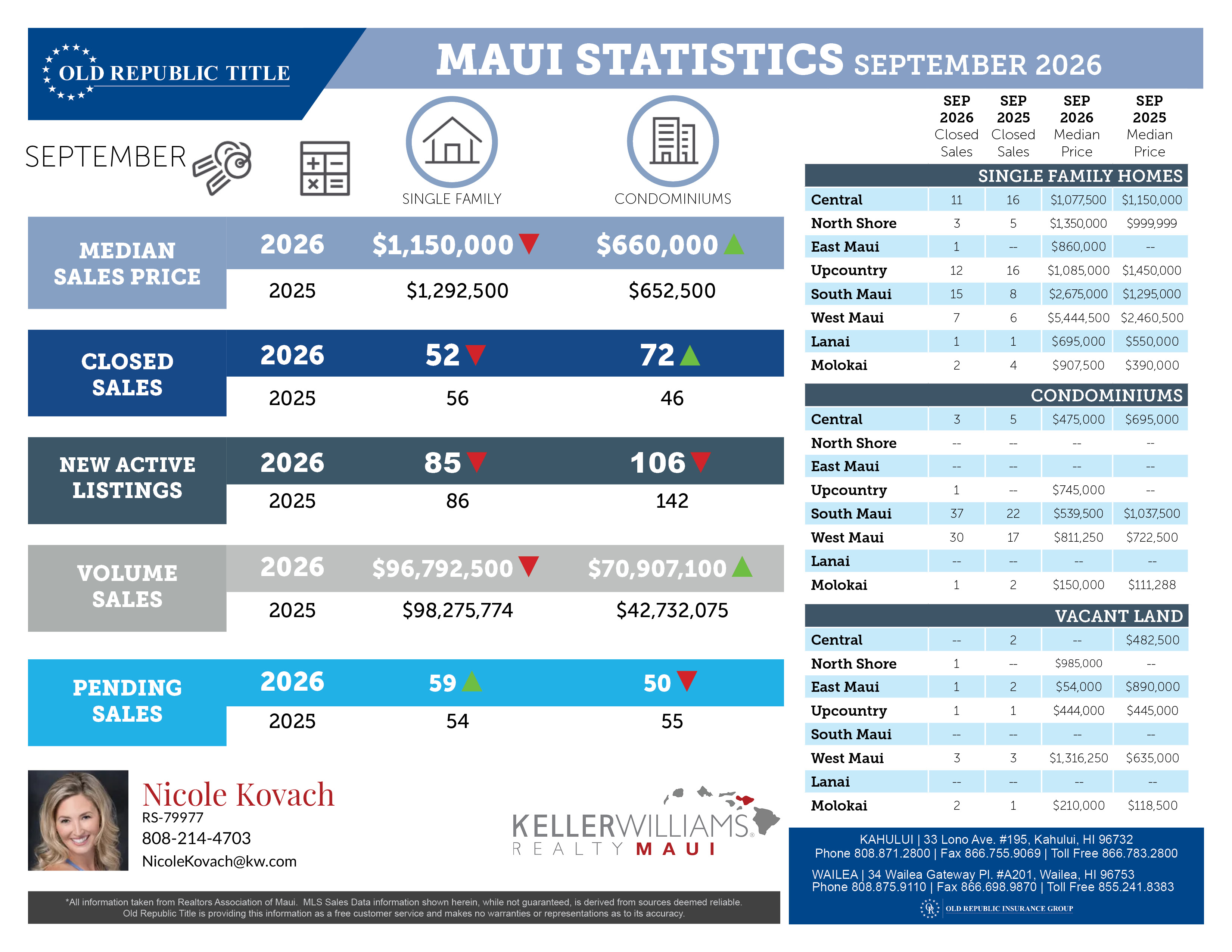
September 2026 recorded 52 closed single-family home sales, compared with 56 in September 2025. The median sales price declined from $1,292,500 to $1,150,000, a decrease of approximately 11%.
Condominiums moved in the opposite direction for sales activity. Closed condo sales increased from 46 in September 2025 to 72 in September 2026, an increase of approximately 57%. The median condo sales price also rose slightly, from $652,500 to $660,000, or about 1%.
New active listings declined across both categories. Single-family listings decreased slightly from 86 to 85, while new condo listings fell from 142 to 106.
These numbers suggest that the single-family market experienced fewer sales and lower median prices, while the condo market recorded considerably more completed sales alongside fewer new listings entering the market during September.
However, one month's statistics do not establish a long-term trend. They provide a useful snapshot of market activity, but buyers and sellers should also consider recent comparable sales, current competition, property characteristics, and longer-term data before making decisions.
What the Numbers Mean for Maui Home Sellers
Single-Family Home Sellers May Need to Reconsider Their Pricing Expectations
The median single-family home sales price fell approximately 11% year over year, from $1,292,500 in September 2025 to $1,150,000 in September 2026.
That is a meaningful change, particularly for homeowners who are basing their asking price on last year's market conditions.
It does not mean every Maui home has lost 11% of its value. The median represents the middle sale in a group of transactions, and the properties sold in each month may differ in location, size, condition, and price range. A change in the mix of homes sold can influence the median.
Still, the decline is a reason for sellers to look carefully at what buyers are paying today rather than relying solely on older sales or personal expectations.
Single-family closed sales also declined from 56 to 52. Meanwhile, new active listings remained nearly unchanged at 85 compared with 86 a year earlier.
This combination suggests that sellers should pay close attention to how their homes compare with competing properties. Buyers may be more selective about price, condition, location, and overall value.
For sellers preparing to list, the priority should be establishing a realistic asking price, presenting the property well, and understanding what similar homes have actually sold for. An ambitious asking price may be possible in certain circumstances, but it needs to be supported by the property's specific features and current market evidence.
Condo Sellers Are Seeing More Sales Activity, but Pricing Still Matters
The condo market recorded 72 closed sales in September 2026, compared with 46 a year earlier. That is a substantial increase in transaction volume.
The median sales price also edged upward, reaching $660,000 from $652,500 in September 2025.
At the same time, new active condo listings declined from 142 to 106.
This combination may look encouraging for condo sellers because more transactions occurred while fewer new listings entered the market during the month. However, it would be premature to conclude that every condo is becoming easier to sell or that sellers can automatically command higher prices.
Condominiums vary significantly across Maui. A property in a resort-oriented community may attract a different buyer from a condo intended primarily for residential living. Association fees, building condition, insurance, reserves, rental restrictions, location, and upcoming assessments can all influence buyer interest.
A condo's asking price needs to reflect these details, not simply the island-wide median.
Sellers should also understand that a higher median price does not necessarily mean individual properties appreciated. The mix of condos sold in September may have differed from the mix sold a year earlier.
The opportunity for condo sellers is to understand which buyers are active in their specific segment and what those buyers are comparing.
The Total Dollar Volume Tells Another Part of the Story
Single-family sales volume reached $96,792,500 in September 2026, compared with $98,275,774 a year earlier. That is a decrease of approximately 1.5%.
Condo sales volume, meanwhile, increased from $42,732,075 to $70,907,100, an increase of approximately 66%.
These figures reflect the combined value of properties sold during the month. They are influenced by both the number of transactions and the prices of the properties that sold.
The condo increase aligns with the rise in closed sales, while single-family volume declined slightly despite the lower number of transactions and lower median price.
For sellers, the important distinction is that market activity and individual property value are not the same thing. A segment can record more sales without every property commanding a higher price.
What Maui Home Buyers Should Know Right Now
More Condo Sales Could Mean More Opportunities to Compare
With condo sales increasing from 46 to 72 year over year, September was a much more active month for completed condo transactions.
For buyers, that provides useful context, but it does not automatically mean there are bargains everywhere or that every seller is willing to negotiate.
The reduction in new condo listings, from 142 to 106, also matters. Fewer new listings entered the market during September, even as more transactions closed.
Buyers should focus on the properties available now, how long they have been listed, recent comparable sales, and whether the asking price reflects the property's condition and ownership costs.
A condo that initially looks affordable may involve substantial association fees, special assessments, insurance-related costs, or restrictions that affect how it can be used. Reviewing the association's financial health and governing documents is an important part of evaluating the purchase.
Buyers considering a condo for rental purposes should also verify the applicable zoning, permitted use, county requirements, and condominium association rules before assuming that short-term rentals are allowed.
Single-Family Buyers May Find More Room for a Thoughtful Negotiation
The lower single-family median price and modest decline in closed sales suggest that buyers should pay close attention to pricing and comparable properties.
However, the statistics do not prove that every seller is under pressure or that every listing is negotiable.
Some homes may be priced competitively and attract strong interest. Others may have asking prices that do not align with recent comparable sales or the property's condition.
The opportunity for buyers is to evaluate each property on its own merits.
Instead of asking only whether the price has dropped, consider whether the property is fairly priced today, what repairs or updates may be needed, how much it will cost to own, and whether similar homes offer better value.
A lower median price can be encouraging, but a successful purchase still depends on choosing the right property at a price that makes sense for your goals and budget.
Buyers Should Look Beyond the Island-Wide Median
Maui is not one uniform housing market. A single island-wide figure cannot explain the differences between South Maui, West Maui, Central Maui, Upcountry, and the North Shore.
A buyer comparing two properties should consider their specific locations, property types, condition, amenities, and intended use.
A condo in South Maui may serve a very different purpose from a single-family home in Upcountry. Even two properties within the same community can differ substantially in value because of their views, privacy, renovations, association costs, or other characteristics.
The best approach is to use broad market statistics as a starting point and then examine the local data that applies to the property being considered.
What the September Statistics Reveal About Different Maui Communities
The regional figures in the September report show why location-specific analysis matters. However, some areas recorded only a handful of transactions, so their monthly median prices can change sharply and should not be interpreted as definitive evidence of appreciation or depreciation.
South Maui
South Maui recorded 15 single-family home sales in September 2026, compared with eight in September 2025. The reported median price increased from $1,295,000 to $2,675,000.
That is a striking change, but it should not be read as proof that typical South Maui home values more than doubled in one year. With relatively few transactions, the types of homes sold can have a substantial impact on the median. A greater share of higher-priced sales can push the monthly figure upward even without a comparable increase in the value of every home.
For condos, South Maui recorded 37 closed sales, compared with 22 a year earlier. Its reported median condo price declined from $1,037,500 to $539,500.
That large difference also requires caution. It may reflect changes in the types of units sold, including their locations, sizes, and price points. Buyers and sellers should compare similar properties rather than treating the two monthly medians as a direct measure of price changes for an individual condo.
For anyone considering Kihei, Wailea, or Makena, the specific neighborhood and property characteristics are essential to understanding the market.
West Maui
West Maui recorded seven single-family sales in September 2026, compared with six a year earlier. The reported median price rose from $2,460,000 to $5,444,000.
As with South Maui, the small number of transactions makes this median particularly sensitive to which properties sold. It should not be treated as evidence that typical home values increased by that amount.
West Maui condos recorded 30 sales, compared with 17 in September 2025. Their reported median price rose from $722,500 to $811,250.
The increase in condo sales is notable, but individual buyers and sellers still need to examine comparable units, building conditions, association finances, and the factors affecting their particular community.
Central Maui
Central Maui recorded 11 single-family sales, down from 16 in September 2025. Its median price declined from $1,150,000 to $1,077,500.
Condo activity was more limited, with three sales compared with five a year earlier. The reported condo median was $475,000, compared with $695,000 in September 2025.
With relatively small transaction counts, these figures are best used as a broad indication of monthly activity rather than a precise valuation guide for an individual property.
Upcountry and the North Shore
Upcountry recorded 12 single-family sales, compared with 16 a year earlier. Its median price was $1,085,000, down from $1,450,000.
The North Shore recorded three single-family sales, compared with five in September 2025. Its reported median price rose from $999,999 to $1,350,000.
Both areas illustrate why buyers and sellers need more than a headline statistic. A few high-priced or lower-priced transactions can have a disproportionate effect on monthly median prices, particularly in communities where sales are limited.
The right comparison should account for property type, condition, location, and recent comparable sales.
Why New Listings and Pending Sales Matter
Closed sales show what has already happened. New listings and pending sales provide additional context about the market's activity.
In September 2026, 85 new single-family listings entered the market, compared with 86 in September 2025. New condo listings declined from 142 to 106.
Pending single-family sales increased from 54 to 59 year over year. Condo pending sales declined from 55 to 50.
Pending sales can offer a useful indication of properties moving toward a transaction, but they are not completed sales. Some transactions may take time to close, and some may not ultimately close at all.
For sellers, pending activity can help provide context about buyer interest, although it should be reviewed alongside active competition and completed sales.
For buyers, new listings show what is entering the market, while pending sales offer some insight into which properties are attracting interest. Neither figure alone establishes whether the market favors buyers or sellers.
The relationship between inventory, new listings, pending contracts, and completed sales is more informative than any one number on its own.
Should You Buy or Sell Property in Maui Right Now?
There is no single answer for every buyer or seller.
For sellers, September's figures reinforce the importance of pricing a property based on current evidence. Single-family sellers should be particularly careful about assuming that last year's median price still reflects today's market. Condo sellers can take note of the stronger sales volume, but should avoid assuming that higher demand applies equally to every building or property type.
For buyers, the statistics offer reasons to examine properties carefully rather than rush into a decision based on broad market headlines. The decline in the single-family median may create opportunities in certain segments, while the rise in condo sales shows that transactions are still taking place. Neither trend guarantees a discount or a particular outcome for an individual purchase.
Your financial position, intended use of the property, time horizon, and tolerance for ongoing ownership costs all matter.
Someone purchasing a primary residence may evaluate a property differently from someone buying a second home. A buyer planning to rent a property will need to verify permitted use and restrictions before relying on potential rental income. A seller preparing to relocate may have different timing and pricing priorities from someone who can wait for a particular offer.
The most useful decision is one based on your circumstances and the evidence for the specific property, not simply on whether the overall market appears to be rising or falling.
Final Thoughts on Maui Real Estate in September 2026
September's statistics show a market with different conditions across property types and communities.
Single-family home sales declined from 56 to 52, while the median price fell from $1,292,500 to $1,150,000. Condo sales increased from 46 to 72, and the median price rose modestly from $652,500 to $660,000. New listings declined for both property types, while pending single-family sales increased and pending condo sales decreased.
For sellers, these numbers highlight the importance of realistic pricing, strong presentation, and an understanding of competing properties.
For buyers, they reinforce the need to evaluate each opportunity carefully, including its condition, location, ongoing costs, and intended use.
The bigger lesson is that Maui real estate cannot be understood through a single median price or one month's sales report. The island's communities and property types behave differently, and the right decision depends on what is happening in the specific segment you are considering.
Whether you are preparing to sell or beginning your search, understanding the numbers is a useful first step. Knowing how those numbers apply to the property in front of you is what makes them valuable.
Frequently Asked Questions About the September 2026 Maui Real Estate Market
1. Did Maui home prices go down in September 2026?
The reported median single-family home sales price declined from $1,292,500 in September 2025 to $1,150,000 in September 2026. The condo median increased slightly from $652,500 to $660,000. These are year-over-year changes in monthly medians, not proof that every property gained or lost value by the same percentage.
2. Are Maui condos selling more than they did last year?
Yes. The report shows 72 closed condo sales in September 2026, compared with 46 in September 2025. This represents an increase of approximately 57% in completed sales for the month.
3. Is September 2026 a good time to buy a home in Maui?
The market statistics can help buyers understand current conditions, but they cannot determine whether a particular purchase is right for them. Buyers should evaluate comparable sales, pricing, property condition, financing, ongoing expenses, and their personal plans before making an offer.
4. Should I lower my asking price if I am selling a home in Maui?
Not automatically. The right asking price depends on the property's characteristics, recent comparable sales, competing listings, buyer feedback, and showing activity. The September statistics suggest that sellers should review current market evidence carefully rather than rely only on last year's prices.
5. Why did the median price change so much in some Maui communities?
Monthly median prices can be influenced by the number and types of properties sold. In areas with only a few transactions, one or two high-priced or lower-priced sales can move the median substantially. Comparing similar properties over a longer period provides better context for understanding local values.
6. What should Maui condo buyers check before making an offer?
Buyers should review the association's governing documents, financial statements, reserve information, insurance, maintenance needs, potential special assessments, fees, parking arrangements, and rental restrictions. They should also verify applicable county requirements and permitted uses rather than assuming a property can be used for short-term rentals.
7. Where can I find reliable information about the Maui housing market?
The Realtors Association of Maui, local market reports, public county records, and recent comparable sales can help buyers and sellers understand market conditions. Monthly reports are useful snapshots, but they should be interpreted alongside property-specific information and longer-term trends.

Nicole Kovach
| Nicole Kovach | Keller Williams Realty Maui
or another way